



AI · AGENTS · LESSONS LEARNED
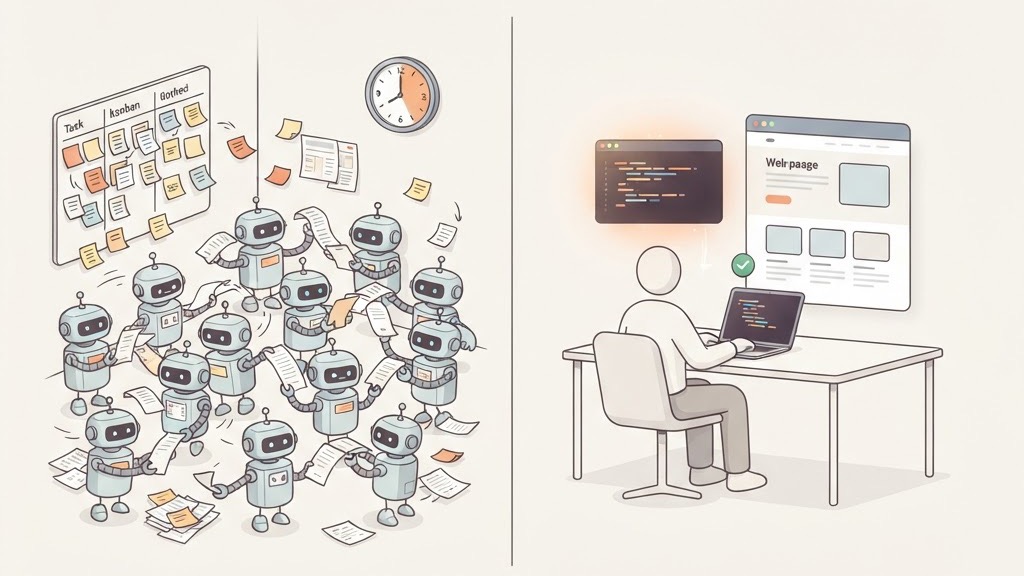
At home, a small team of AI agents runs around the clock. Hermes, the main bot, receives my requests on Telegram and hands them to specialists: one bot for infrastructure, one for home automation, one for movies, one for health… and Blogscribe, in charge of this blog. On paper, it is the most powerful setup I have ever built: long-term memory, a shared kanban board, dozens of installed skills, automatic routing between models.
One Saturday evening, I asked it for something simple: reformat an article. Not rewrite it, just make it readable. An hour later, I still had nothing. I opened Claude Code on my Mac, pasted the conversation in, and the article was fixed within minutes.
This post tells the story of that evening, because it says something important about AI agents today.
An Hour of Kanban for a Page Layout
Here is what happened, in order:
- Hermes turns my request into a kanban card for Blogscribe, rephrasing it along the way.
- Blogscribe blocks the card: my request is not clear enough. A multiple-choice question.
- New card, new block: changing its own behavior requires approval. Another question.
- I insist: I want a result. Hermes creates a third card, longer than the previous one: diagnose the briefing, prepare an offline preview, a diff, a rollback procedure…
- In the bot’s workspace, there is a generic essay on “the editorial workflow”. Nothing about my article.
Meanwhile, the meters were running: more than two hundred model calls over the day for this one bot, and an estimated ten dollars or so of uncached tokens. Every message I sent to speed things up produced a new card, and therefore a new detour.
And the article itself? The version Blogscribe had produced earlier used Bootstrap components (cards, grids, an accordion) that my theme does not load. As a result, the six steps of the tutorial were folded into an accordion that never opened. An unreadable article.
Claude Code: A Few Minutes, Text Untouched
Claude Code did not open a ticket. It read the article directly in WordPress, spotted the problem, rebuilt the page with native Gutenberg blocks (headings, lists, a quote, a code block), then checked with a script that the visible text was identical word for word before publishing. The old version remained available in WordPress revisions.
Only then did it look into why the bot had failed. The diagnosis comes down to four points:
- No tool. Blogscribe could upload images to the blog, but could neither read nor edit an article. So it fumbled around and invented its own formatting.
- Contradictory instructions. “Draft by default”, “ask for approval”, “write with Codex or stop”: every small touch-up became an approval circuit.
- A polluted context. Its memory was about home automation, résumés and IPTV, but not the blog. And more than a hundred and sixty generic skills were loaded, from p5.js animation to model deployment.
- An overzealous conductor. Hermes rewrote every request into a specification, each time adding requirements I had never expressed.
Same Tools, Same Instruction… and Still a Gap
The easy conclusion would be: “it was a configuration problem”. So Claude Code fixed everything. Blogscribe received a clean tool to read and edit an article, with automatic backup and a refusal of any HTML the theme cannot display. Its instructions were rewritten, its memory cleaned up, its useless skills disabled. Hermes received a simple rule: pass my requests along word for word.
Then I ran a test. I told the bot that, in the article, the section title and the steps were the same size. It used the right tool and it was fast… and it set the steps to the same heading level as the section. Exactly the opposite of what was needed. Faced with the same sentence, Claude Code measured the sizes displayed in the browser (36 px versus 30 px, both bold). It understood that the problem came from the theme and not from the article, then added a rule in WordPress’s additional CSS, without touching the theme’s code.
Tooling explains part of the gap. The rest is the model: understanding what you mean, not just what you write.
What I Take Away
A multi-agent architecture does not make a model smarter. It multiplies intermediaries, and every intermediary rephrases. When the model at the end of the chain misreads a request, the kanban, the skills and the memory only organize the error.
Three rules now seem essential to me:
- One precise tool beats a hundred skills. An agent without the right access improvises, and improvisation is expensive.
- The request must arrive intact. An orchestrator passes things along, it does not embellish.
- The right model in the right place. Hermes remains very good at routing, summarizing and monitoring. But to carry out precise work, it now delegates to Claude Code.
That is the decision made that evening: Blogscribe keeps the conversation and hands every article touch-up to Claude Code. The bot stays the switchboard; Claude does the work.
