


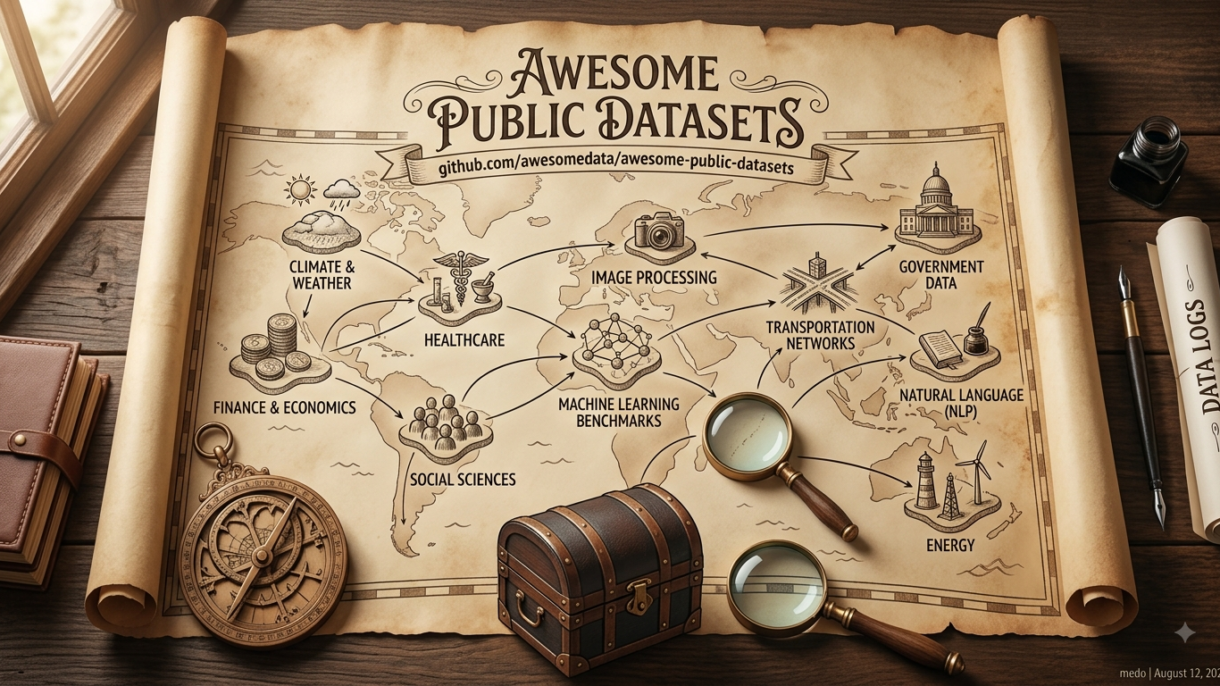

If you have ever started a machine learning project, built a dashboard, written a research paper, or simply wanted to explore real-world data, you already know the hardest part is often not the code. It is finding a good dataset.
That is why the GitHub repository Awesome Public Datasets is such a valuable resource. It is a curated collection of public datasets organized by topic, making it easier for developers, researchers, analysts, students, and data enthusiasts to discover high-quality data sources without spending hours searching across the web.
Whether you are looking for climate records, economic indicators, social network graphs, image datasets, government data, healthcare resources, or machine learning benchmarks, this repository acts like a map to the public data ecosystem.
What Is Awesome Public Datasets?
Awesome Public Datasets is an “awesome list” dedicated to topic-centric public data sources. Like other awesome lists on GitHub, its goal is simple: collect useful links in one place and organize them so people can find what they need quickly.
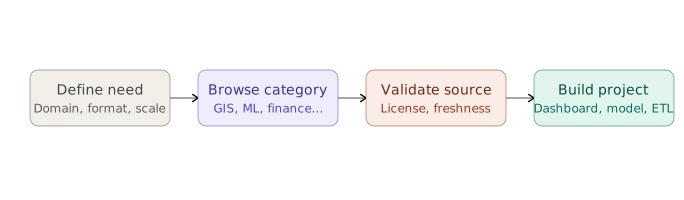
The repository includes datasets from a wide range of domains, including agriculture, biology, chemistry, climate and weather, cybersecurity, economics, education, energy, finance, GIS and geospatial data, government, healthcare, image processing, machine learning, natural language processing, neuroscience, physics, social sciences, software, sports, time series, and transportation.
It also includes complementary collections, which can lead users to even more dataset repositories and archives. In short, it is not a single dataset. It is a gateway to hundreds of datasets.
Why This Repository Is So Useful
The internet is full of data, but not all data is easy to find, clean, documented, or usable. Many valuable datasets are buried inside university pages, government portals, academic archives, old project websites, or research labs.
Awesome Public Datasets helps solve that discovery problem. Instead of searching Google for “free public dataset for network analysis” or “open agriculture data,” you can browse a categorized list and quickly find relevant sources.
For example, the repository points to well-known resources such as the Stanford Large Network Dataset Collection for graph and network research, Open Food Facts for food product data, NBER Patent Citations for economics and innovation research, DIMACS Road Networks Collection for transportation and graph algorithms, and many climate, biology, finance, and machine learning datasets.
Each listing usually includes a short description and a link to the original data source. Many entries also include metadata links from the repository’s companion project, apd-core.
A Dataset Directory for Many Audiences
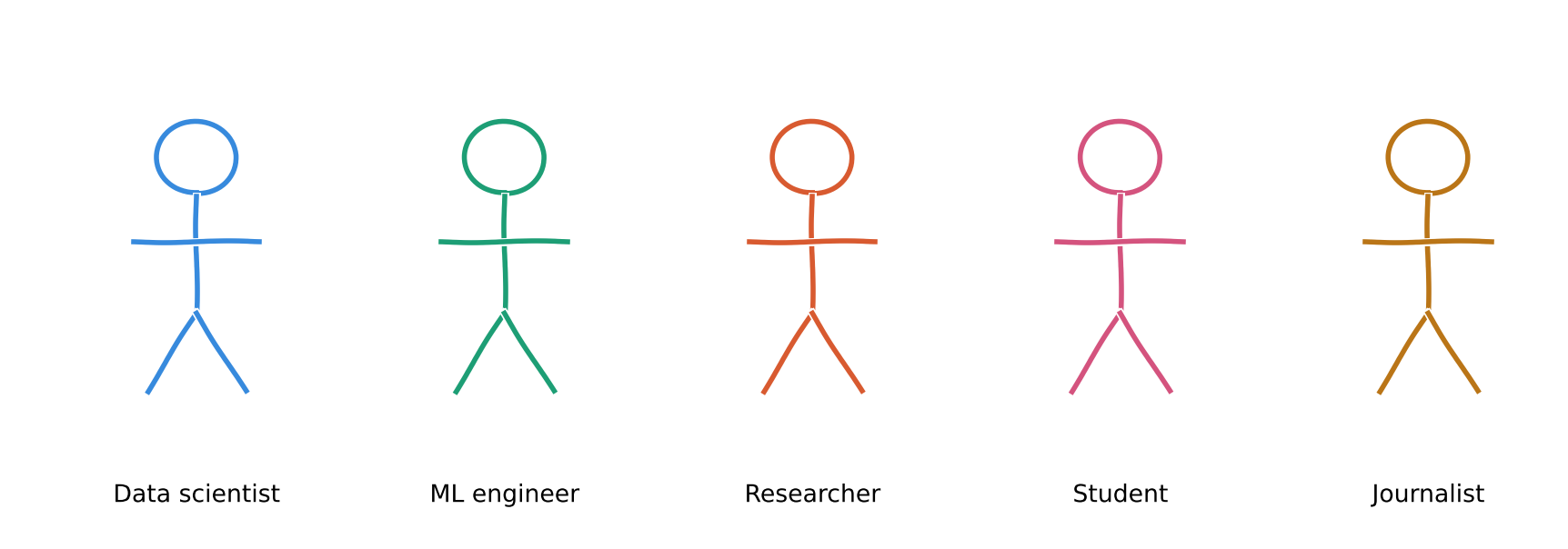
For Data Scientists
Data scientists can use it to find datasets for exploratory analysis, predictive modeling, visualization, and portfolio projects. Instead of working with the same few beginner datasets repeatedly, they can explore more specialized real-world data.
For Machine Learning Engineers
Machine learning engineers can find benchmarks and domain-specific data for experimenting with models. Categories like image processing, natural language, time series, and cybersecurity are especially useful for ML workflows.
For Researchers
Researchers can discover public data sources related to biology, physics, neuroscience, social sciences, climate, economics, and more. The repository can serve as a starting point for literature reviews, reproducible experiments, or interdisciplinary research.
For Students
Students learning Python, R, SQL, data visualization, or statistics can use the repo to find project ideas. Real datasets make learning more meaningful because they contain imperfections, surprises, and domain context.
For Journalists and Analysts
Data journalists and analysts can use the collection to locate public-interest datasets, especially in government, economics, transportation, education, healthcare, and climate.
What Makes It Better Than a Random List of Links?
The strength of Awesome Public Datasets is not just that it contains many links. It is the organization and curation.
The datasets are grouped by domain, so browsing feels natural. If you are interested in geospatial analysis, you can jump to GIS. If you are researching transportation networks, you can explore Transportation or Complex Networks. If you are looking for NLP resources, there is a Natural Language section.
The repository also uses status icons for entries. Some links are marked as healthy, while others are marked as needing attention. That is important because public dataset links often break over time. Seeing that maintenance status gives users a quick signal about whether a resource may need verification.
Another important detail: the README notes that the repository is automatically generated by apd-core. Contributors are asked not to edit the generated README directly, but to contribute through the appropriate metadata workflow. That makes the project more structured than a hand-edited list.
Great Project Ideas Using Awesome Public Datasets
- Build a climate dashboard: Use climate and weather datasets to visualize temperature changes, rainfall patterns, or extreme weather events over time.
- Analyze transportation networks: Explore road network datasets or public transport data to study shortest paths, congestion, or urban accessibility.
- Create a food product explorer: Use Open Food Facts or other agriculture and food datasets to analyze nutrition, ingredients, product origins, or labeling trends.
- Study social networks: Use graph datasets from the social networks or complex networks sections to learn network analysis, centrality, community detection, and graph visualization.
- Practice time series forecasting: Find time series datasets related to energy, finance, climate, or transportation and build forecasting models.
- Train an image classification model: Browse image processing datasets and experiment with computer vision techniques.
- Investigate public policy questions: Government, education, economics, healthcare, and social science datasets can support projects around inequality, public spending, population trends, or policy outcomes.
If you want help turning one of these datasets into a production-ready pipeline — ETL, storage, or a deployed model — check out my data engineering services or get in touch.
A Few Things to Keep in Mind
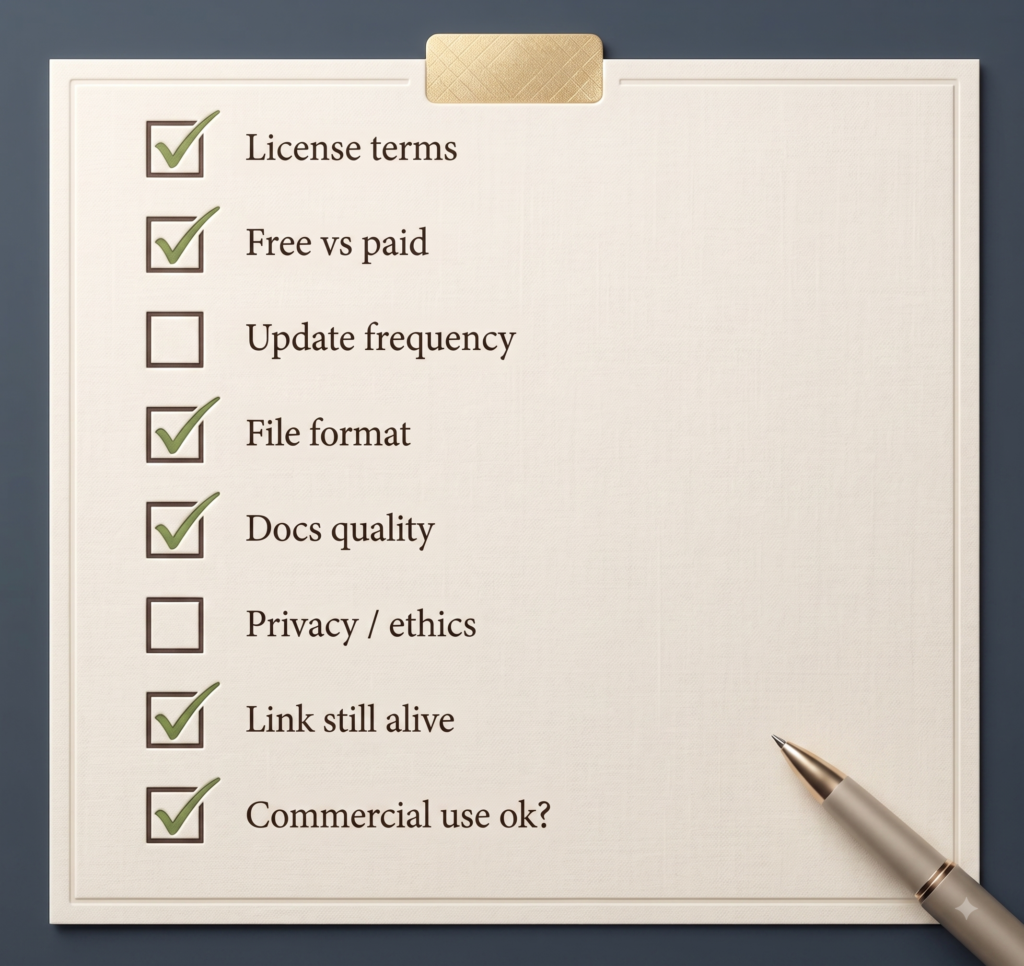
Awesome Public Datasets is a directory, not a guarantee that every dataset is ready to use immediately.
Before starting a project, you should always check the dataset license, whether the data is free or requires payment, update frequency, file format, documentation quality, privacy or ethical considerations, whether the link is still active, and whether the dataset is suitable for commercial use.
The repository itself notes that most datasets are free, but some are not. That distinction matters, especially for production or commercial projects.
Also, because many datasets come from third-party sources, quality can vary. Some may be clean and well-documented, while others may require significant preprocessing.
Why Public Datasets Matter
Public datasets are one of the foundations of modern data work. They make research more transparent, help students learn by doing, allow developers to test ideas, and enable journalists and citizens to investigate important questions.
Open data also lowers the barrier to innovation. A student with a laptop can analyze climate trends. A developer can build a prototype with public transportation data. A researcher can compare results using shared benchmarks. A startup can validate an idea before collecting proprietary data.
Repositories like Awesome Public Datasets make that ecosystem easier to navigate.
Final Thoughts
Awesome Public Datasets is one of those GitHub repositories worth bookmarking immediately. It saves time, sparks ideas, and opens doors to data from dozens of fields.
If you are learning data science, building machine learning models, writing research, creating visualizations, or looking for your next portfolio project, this repository is an excellent place to start.
The next time you ask, “Where can I find a good dataset?”, start with Awesome Public Datasets. And if you need a hand turning that data into something real — a dashboard, a model, a pipeline — I do this for a living. Let’s talk.
