




For several years, much of the discussion around Bitcoin has rested on one central idea: cyclicality.
Halvings, four-year cycles, an “inevitable” bull run, and an equally expected bear market. The narrative is well-oiled, almost comforting.
But one question deserves to be asked plainly:
Can we really call it serious analysis when we are waiting for a phenomenon that is supposedly obvious and predictable?
What supporters of cyclicality argue
Defenders of this view mainly rely on three elements:
- Historical data: since 2012, the major bullish phases have followed halvings.
- Programmed scarcity: the reduction in issuance is supposed to mechanically influence price.
- The repetition of human behavior: euphoria, excess, correction, forgetting, then return.
Taken individually, these elements are not absurd. The problem begins when they are presented as an almost deterministic mechanism.
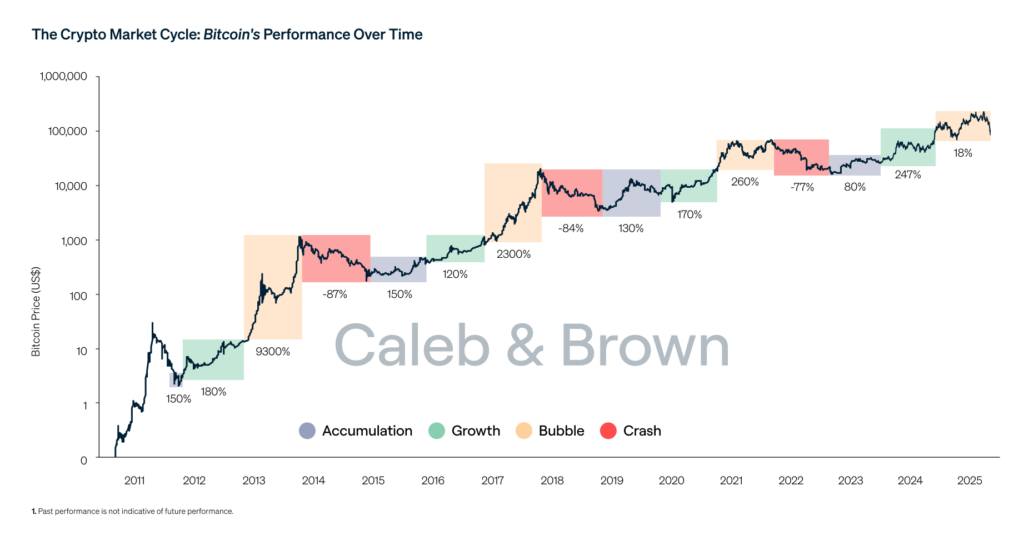
Where the reasoning becomes fragile
1. A ridiculously small statistical sample
Bitcoin has existed for just over fifteen years.
Speaking of robust cycles based on three or four occurrences is closer to storytelling than science.
In finance, no one would describe that as a usable time series with a high level of confidence.
2. Confusing correlation with causation
The fact that rallies followed halvings does not prove that:
- the halving is their main cause,
- or that the same pattern will repeat identically.
The markets of 2013, 2017, and 2021 had nothing in common in terms of liquidity, participants, regulation, or macroeconomics.
3. A self-fulfilling prophecy
The more an idea is repeated, the more it influences behavior.
- Investors buy “before the halving”
- The media amplify the narrative
- Flows become synchronized
The cycle then becomes a social artifact, not a market law.
It works… until the day it no longer does.
Technical analysis: tool or illusion of control?
Technical analysis is not useless in itself. It is effective for:
- reading collective behavior,
- identifying liquidity zones,
- managing short- or medium-term risk.
But it does not turn an asset as young, political, and narrative-driven as Bitcoin into a predictable metronome.
Believing otherwise means confusing reading the past with the ability to forecast.
What Bitcoin really is
Bitcoin is not:
- a stock with cash flows,
- a traditional commodity,
- a mature asset.
It is all at once:
- a technological object,
- an experimental monetary asset,
- an ideological symbol,
- a field for global speculation.
Reducing all of that to a simple cyclical curve is intellectually comfortable, but analytically poor.
So, is skepticism a mistake?
No.
Being skeptical of cyclicality presented as obvious is, on the contrary, a way to:
- reject overly neat narratives,
- avoid lazy certainties,
- maintain an open analytical stance.
The real danger is not doubting cycles.
The real danger is mistaking them for natural laws.
Conclusion
Bitcoin cyclicality is a useful narrative, sometimes effective, but never guaranteed.
It helps structure expectations, not predict the future.
In a market this young and shifting, the only truly rational position remains intellectual caution.
The day the “obvious” cycle fails, it will not be an anomaly.
It will simply be the market reminding us that it owes nothing to our charts.
