


An AI assistant becomes interesting when it fits into the way people work. Answering a question is a start; helping turn an intention into a useful action requires context, the right tools and an understanding of when to stop.
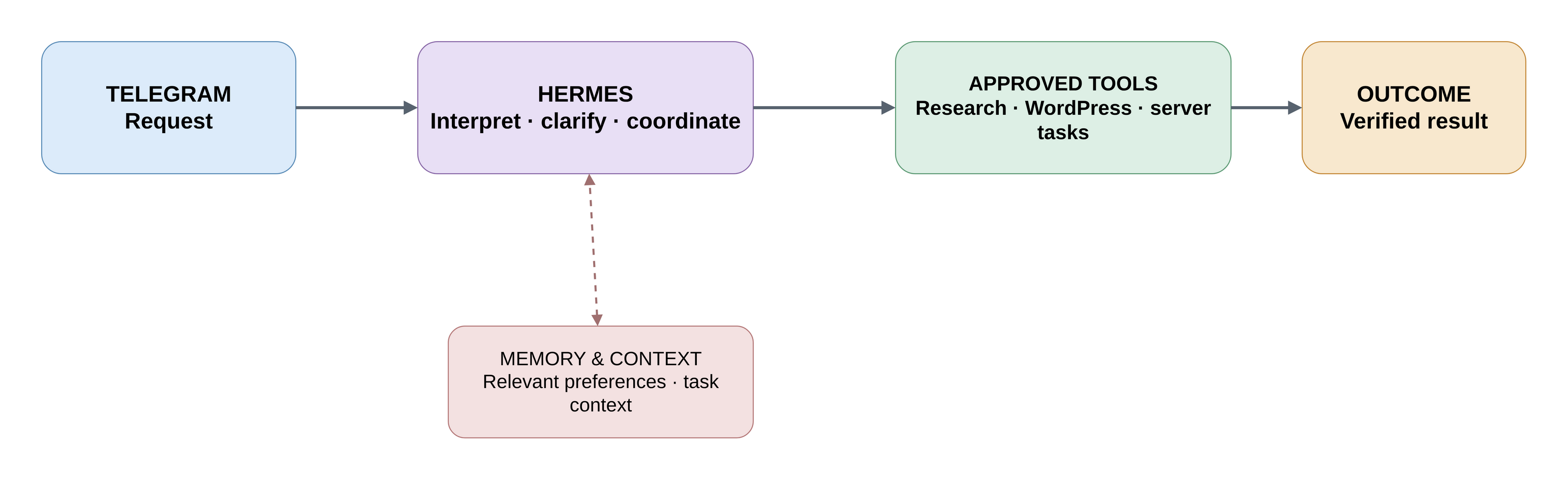
Hermes is a personal AI assistant accessible through Telegram. It can draw on tools and integrations for tasks such as web research, WordPress and server administration. The project provides a concrete setting for a broader question: how do you design an assistant around real workflows rather than a list of features?
Start with the work
A request such as “prepare a summary of this topic” sounds straightforward. In practice, it can involve several steps: clarifying the need, finding sources, separating facts from assumptions and presenting a usable result. A request involving a website or server may instead touch data or trigger changes.
Those tasks do not all call for the same degree of autonomy. Research can produce a proposal for review; an operation that changes content or a system deserves an appropriate check before execution. Start with the desired outcome, then consider the decisions and tools needed to reach it.
A useful assistant is measured less by the number of tools it can call than by the quality of the steps it helps complete.
Telegram as an entry point
Telegram provides a familiar interface for making a request and receiving a response. That simplicity has a useful design implication: a conversation can begin with an intention, without requiring someone to choose a tool or procedure first.
A short exchange does not always contain enough information, though. “Update this article” says neither which content is meant nor what should change or how the result should be approved. A well-scoped assistant needs to be able to ask for those details, present a proposal or say when it lacks the necessary context.
Capabilities with clear boundaries
Connecting an assistant to tools expands what it can do, but every capability brings decisions that need boundaries. Reading a page, preparing a WordPress draft and changing a server have different consequences.
A careful approach is to define for each workflow:
- The objective: what result should the request produce?
- The scope: which information and tools are needed?
- The checkpoint: when should a result be presented or approval requested?
- The limit: what happens if information is missing or an operation fails?
These questions make actions easier to understand and verify. They also help prevent a plausible answer from being mistaken for a completed task: when a tool is involved, its result should be distinguishable from what the assistant proposes or infers.
Memory and context, used selectively
A personal assistant can provide continuity when it can take relevant preferences or information from one exchange into the next. But keeping everything is neither necessary nor desirable. A lasting preference, the temporary context of a search and sensitive information should not all be treated as one category.
The design choice is to retain what actually helps future work, keep context tied to its purpose and allow it to be corrected when it becomes inaccurate. The assistant also needs to account for incomplete or outdated context: it should say so rather than fill the gap with apparent certainty.
One interface, different kinds of work
The value of an assistant like this lies in the transitions between steps. For web research, it can help turn a question into leads and then a summary to verify. For WordPress, the work can move from preparing text to reviewing it before any change. For server administration, the distinction between diagnosis, proposal and action is particularly important.
These examples describe ways to frame work, not a promise that every operation is automated or successful. In each case, the result still needs evaluation: are the sources relevant, does the text reflect the intended message, and does a proposed command fit the system concerned?
What the project brings into focus
Hermes illustrates the appeal of a conversational interface connected to practical tools, as well as its limits. A model can misunderstand a request, miss context or produce a convincing but incorrect answer. Tools can fail or return insufficient information. Access through a messaging app does not remove the need for human review.
The design lesson is incremental: start with understandable tasks, make the steps visible and match autonomy to the consequences. A good workflow leaves room for questions, verification and correction.
